Rapid Technological Change


UN Call for Inputs on the
Impacts of rapid technological change on the achievement of the Sustainable Development Goals
14 Dec 2018 – 31 Jan 2019
Note: All earlier submissions in March 2018 will also be considered in this round.
The Interagency Task Team on Science, Technology and Innovation for the SDGs is calling upon scientists, engineers, economists and policy analysts to contribute to a report on the impacts of rapid technological change on the achievement of the UN Sustainable Development Goals (SDGs). You may want to consider the following types of contributions focused on one or more of the questions listed in this announcement below:
- Written, informal responses highlighting empirical evidence and your views grounded in the literature (peer-reviewed references and background papers); and/or
- Short science-policy briefs comprising abstract, outline of empirical facts and issues, and policy The briefs are limited to a maximum of 1,600 words including tables and figures. Annexes are not included in the word count. Upon review and acceptance, the brief will be published.
We are looking forward to your submissions to roehrl@un.org, clovis.freire@unctad.org, and bob.bell.jr@unctad.org, as soon as possible and hopefully no later than 31 January 2019.
This work aims to focus on rapidly emerging technologies that progress so fast and have such broad-ranging socio-economic and environmental impacts so they pose serious challenges for institutions to adapt. Examples include – but are not necessarily limited to – highly interdependent, emerging technology clusters in the areas of automation, robotics, artificial intelligence, biotechnology, nanomaterials, and various digital technologies.
The UN Secretariat will synthesize contributions from experts within the UN system and beyond, in the form of a report and presentation. This work will build on earlier UN expert group meetings held in 2016 and 20181 and ongoing work under the Technology Facilitation Mechanism.
All contributors will be acknowledged in the report, unless requested otherwise. Please feel free to focus your answers on the questions that are most related to your work and expertise. You may also propose to refine the questions themselves and/or add other important questions. Please include full references, especially empirical evidence, in support of your contributions. You may also wish to share copies of relevant articles and data with us.
Disclaimer: We acknowledge that some of the questions are far-reaching and difficult to give a straightforward answer. Nevertheless, we hope you will give it a try. If in doubt, imagine you were part of a panel discussion and confronted with these questions.


Te puede interesar
Talleres virtuales
Laura Gutiérrez - Sep 17, 2026Con el objetivo de transmitir conocimientos y desarrollar habilidades específicas que contribuyan a la práctica docente, la investigación, la innovación,…
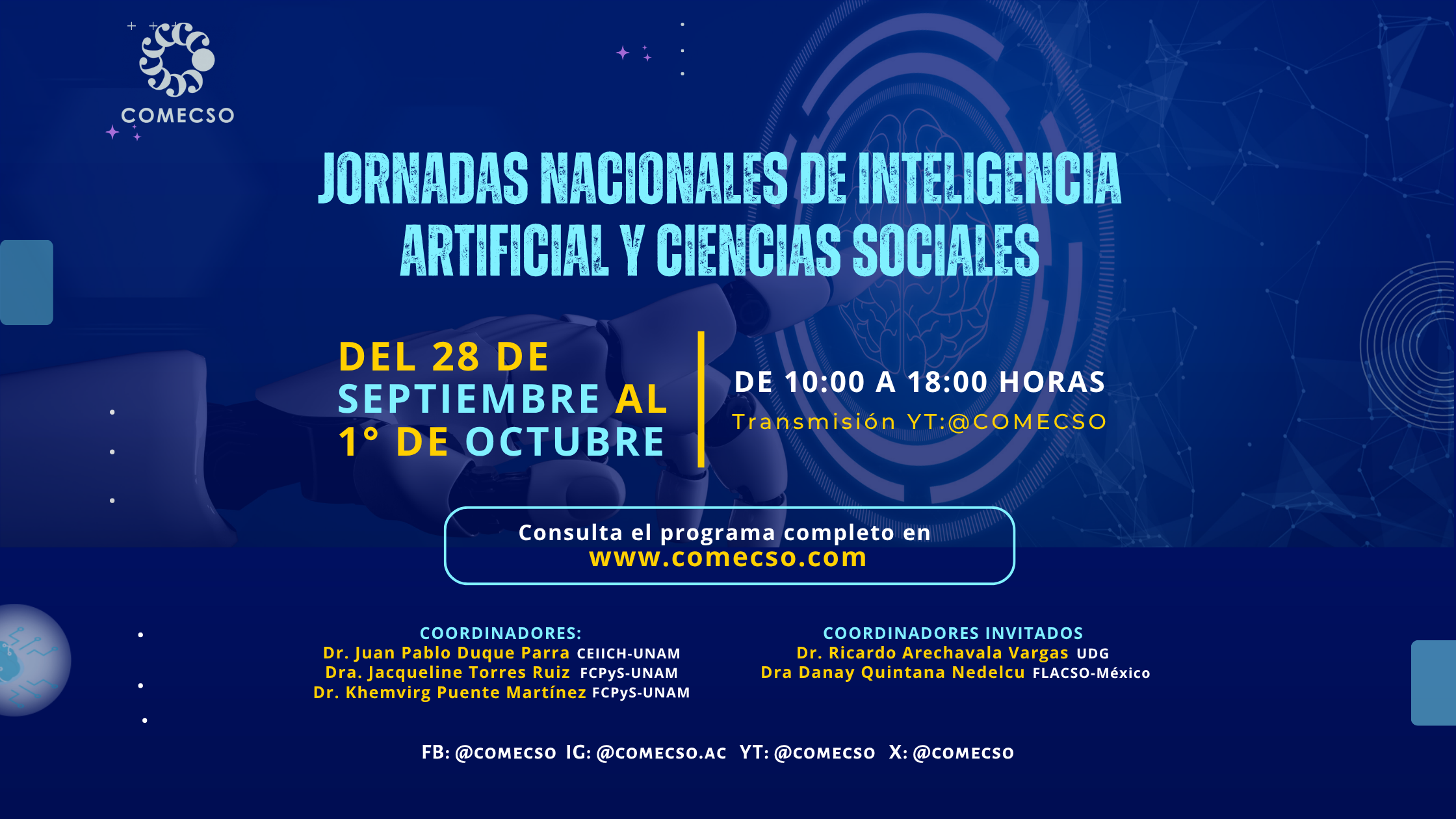
Horizontes de investigación sobre la Inteligencia Artificial desde las Ciencias Sociales
comecso - Sep 14, 2026Coords. Juan Pablo Duque, Khemvirg Puente y Jacqueline Torres-Ruiz Objetivos: Invitar a especialistas de todas las disciplinas de las Ciencias…
Call for papers – Mobilization: An international quarterly
Alejandra Valdés Teja - Sep 26, 2026https://laoms.org/convocatorias/call-for-papers-mobilization-an-international-quarterly
Simposio Comunicación, tecnologías e inteligencia artificial
comecso - Sep 22, 2026Comunicado 1_Simposios en Comunicación ICA 2027

¿Qué esta ocurriendo en el Caribe con el sargazo?
Laura Gutiérrez - Sep 21, 2026Centro de Investigaciones y Estudios Superiores en Antropología Social Seminario Permanente: Turismo, globalización y sociedades locales Tenemos el gusto de invitarles…
Grupos de trabajo
Horizontes de investigación sobre la Inteligencia Artificial desde las Ciencias Sociales
comecso - Sep 14, 2026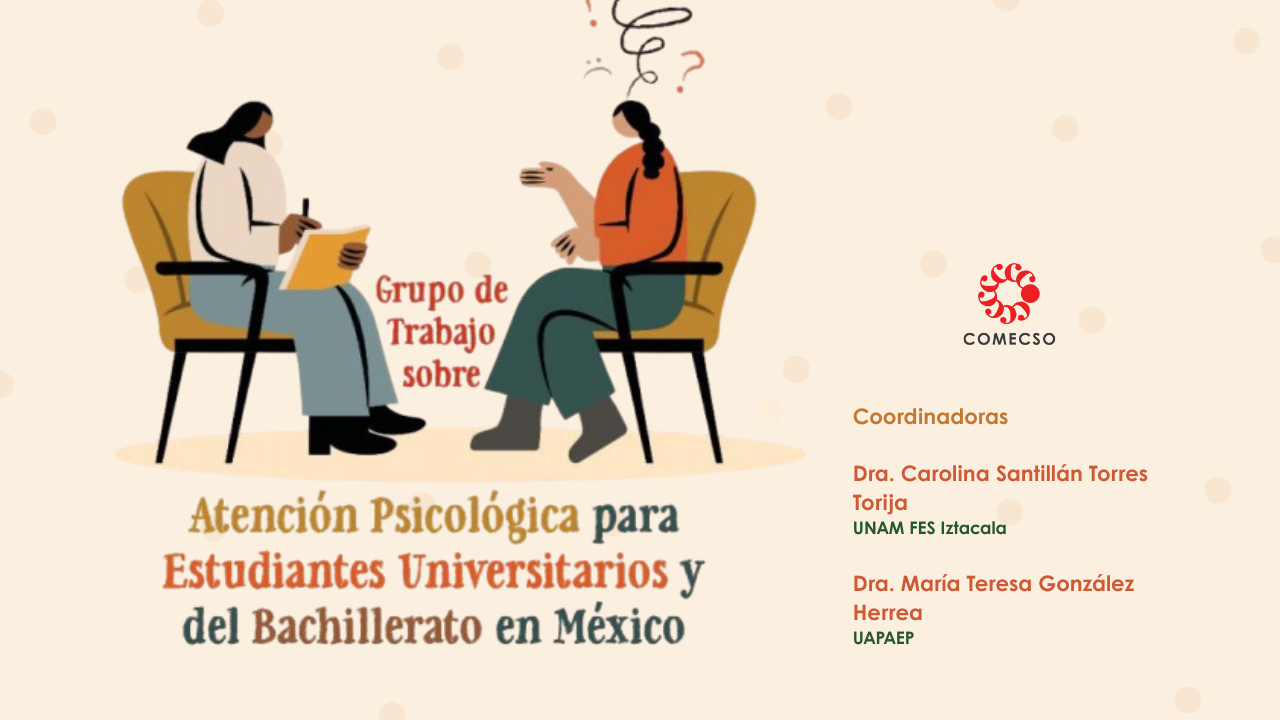
Atención Psicológica para estudiantes universitarios y del bachillerato
Laura Gutiérrez - Jul 27, 2026Destacadas
Horizontes de investigación sobre la Inteligencia Artificial desde las Ciencias Sociales
comecso - Sep 14, 2026